< A Personal Summary of the Oct 1, 2011 Debate between Dr. Bart Ehrman and Dr. Dan Wallace
Ehrman's (the agnostic) points are in red, Wallace's (the evangelical) are in blue, and purple where they agreed.
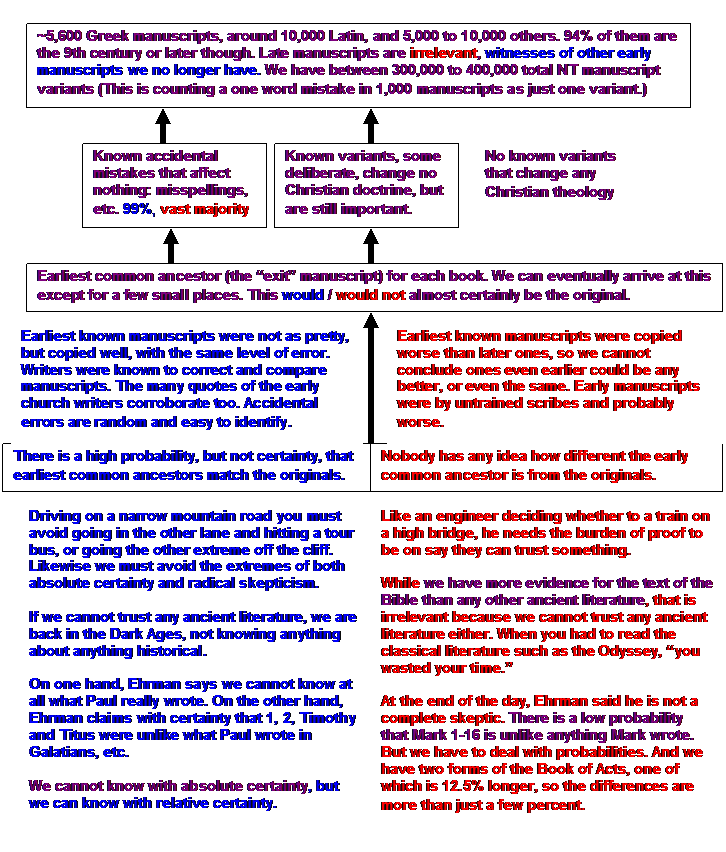
Examples Ehrman brought up of manuscript variants that are important, but change no Christian doctrine are Luke 22:19-20, did Jesus heal a leper out of anger or not, John 7:53-8:11, the longer ending of Mark, and 1 John 5:7,8. Ehrman later said that when his grandfather says that 1 John 5:7,8 was not in non-KJV Bibles he said "they took the Trinity out of the Bible!" Another example is 616 vs. 666 in Revelation.
Dr. Wallace said that if you stacked all existing manuscripts of classical Greek literature, you would get a stack 4 feet high. The stack of all existing New Testament manuscripts would be over a mile high. Later, on Nov 1, 2011 Wallace said he showed something incorrectly in the debate. When he was comparing the height of Greek non-Biblical manuscripts to Greek New Testament manuscripts, he over-represented the non-Biblical Greek manuscripts. In one place where he said the stack was ' as high, he should have said it was 1/16 as high.
On Nov 1, 2011 I asked how the differences in Greek manuscripts compared to differences between modern translations such as the NIV vs. the NKJV or KJV. He said the differences in Greek manuscripts were closer that the differences between the NIV and NKJV or KJV. Wallace said the oldest Greek manuscripts used in the KJV were only about 500 years before the KJV.
Wallace said that the western family of manuscripts is generally corrupt. But we can tell they are corrupt because they are not uniform in their mistakes.
Both were asked about the textual integrity of other gospels and letters that were not in the New Testament. They said that for most of them there are very few copies to know. Ehrman said that the Protoevangeliumof James has about 500 copies, because it was a popular medieval work. It is not any better, as far as transmission errors, than the New Testament books. Wallace said it actually was much worse. He went on to point out that we have one Coptic and two Greek papyrii of the Gospel of Thomas, and they show extensive large changes.
Dr. Ehrman was asked a question about the selection of books and selection of manuscripts that occurred under Constantine at the Council of Nicea. Ehrman said we have the proceedings of the Council of Nicea, and they did not address the books of the New Testament Canon, and they did not discuss any manuscripts. He said this is a popular myth with no support.
In responding to a question Dr. Wallace said he was not a fundamentalist, but an evangelical. He said that he and Ehrman are pretty much agreed on which variants are the correct ones, and which ones should be out (John 7:53-8:11, long ending of Mark, John 5:7,8, etc.)
Dr. Wallace (the senior editor of the New Testament portion of the .NET Bible) was asked a question on which English Bible translations he would recommend. He said the best are the new NIV, NRSV, and .NET Bible.
Wallace says that Dr. Ehrman wrote a helpful book debunking The da Vinci Code.
Ehrman said that manuscript p66 had a ton of mistakes. Apparently the scribe was more concerned with making pretty letters than accuracy.
Ehrman was one of the authors of the Fourth edition of the Text of the New Testament.
Dr. Wallace pointed out some inconsistencies with Ehrman's view in his books and his premise in the debate. Ehrman said that since The Orthodox Corruption of Scripture, written 19 years ago, he has changed his mind. He used to think you could reconstruct the original Greek text from the manuscripts, (and wrote that way),but now he thinks it cannot be done. He will come out with a second edition of the Orthodox Corruption of Scripture. Ehrman says he still thinks you can reconstruct the earliest form of the text. But we can't [and will never] be able to tell the originals before the earliest forms.
Ehrman was asked, hypothetically what evidence would have to appear for him to change his view. He said that if somehow 10 copies of early manuscripts were found somewhere, say Rome, dated within ten years after writing, that should 0.001 % variation from each other, then he would change his view.
Ehrman said that authors do not usually get to choose the titles of their books. He did not prefer the title of his book "Misquoting Jesus...", but rather suggested the title "Lost in Transmission".
On the Dead Sea Scrolls, Ehrman said that the Isaiah scroll is basically the same as we have in the Masoretic text, 900 years later. However, Samuel is very different. Wallace added that both Samuel and Jeremiah are a mess in the Dead Sea Scrolls.
Ehrman brought up that in Matthew 1:16, instead of saying "Joseph, betrothed to Mary, who begat Jesus, a Syriac version says, "Joseph begat Jesus." However, Ehrman that nobody thinks the Syriac is more correct here.
Dan Wallace, the evangelical, and Bart Ehrman, the apostate agnostic seemed very chummy and complimentary of each other. At the very end, one person (it was either the moderator or Wallace) said both were searching for the truth.
The difference between the first surviving copy of a Greek manuscript and the original is: 800 years for Plutarch, around 700 years for Pliny the Elder, 800 years for Josephus, Pausanias 1400 years, Polybius 1200 years, Herodotus 1500 years, Xenophon 1800 years.
We have preserved almost every verse of the New Testament over a 1300 year period, with over a million quotes.
On Nov 1, 2001 Wallace said all the manuscripts are in agreement 90% of the time.
Neither one directly addressed the question "You can trust the New Testament manuscripts for what?" i.e. can you trust that every word is correct, can you trust the basic salvation message, or where is the uncertainty. Ehrman seemed to imply you can only trust that is not totally dissimilar to what Jesus taught.
Ehrman has written 26 books, including two New York times bestsellers. A lot of Ehrman's material was apparently taken from his book "the orthodox corruption of scripture." Wallace has written 8(?) books. One, Revisiting the Orthodox Corruption of Scripture, was first released at the debate.
When Ehrman says he no longer believes some of the things he wrote, Wallace pointed out that some of those were in the 2005 work, The Text of the New Testament by Metzger and Ehrman. Also there is The New Testament : A Historical Introduction 5th edition, 2011.
There is a new edition of The Orthodox Corruption of Scripture 2nd edition 2011.
Wallace gives an example of how many changes in the Greek do not change the meaning. He says you can say the sentence "Jesus loves Paul" in Greek in 16 different ways without changing the meaning.
Ehrman says the scribes were not trained. But then he says those [accidental] errors are the easiest to detect. Wallace says that a worst-case scenario would be a controlled environment going in an inauthentic direction. This is the situation with the Qur'an.
Wallace said the copyist of p75, while not a professional scribe, copied one letter at a time, based on his mistakes, which generally are no more than two letter mistakes.
Wallace said that on all variants, we know the original text, as one of possibilities A, B, C, or D. So we have all of the original text, but the problem is that in many variants we cannot be certain which of the variant readings is the original.
Three points that shape which variants scholars decide is probably the original.
1) If the majority is generally right, when do we not use the majority?
2) What do we count? Do we count only Greek manuscripts or all manuscripts?
3) We cannot just notice the number for each variant, but we to look at the quality of the manuscripts containing the variants too.
In the New Testament manuscripts, there is only one place where a variant actually has an error.
Gospel of Thomas 120-180 A.D. Half of it is right out of the New Testament. It has no miracles, no city, town, or site mentioned. IT has no narrative.
In the Byzantine Lectionary, the copies are extremely similar to each other. Many variants from other manuscripts are very predictable: man of the pronouns are changed to nouns. Since verses from the lectionaries were read in isolation on Sundays, they filled made these changes, without altering the meaning, so that readers would understand.
(My note) For example, in most other manuscript, in Matthew 5-7, there are 120 verses in a row were Jesus/Christ/Lord is used in only three places. They are: "Lord, Lord" in Mt 7:21 and "Jesus" in Mt 7:28.
Good book: Contending with Christianity's Critics
84 scholars participated in the Jesus Seminar over 8 years.
Wallace said p75 is late 2nd or early 3rd century. He said p52 was 100-150 A.D. (Nov 1, 2011)
The Septuagint of Jeremiahs is 1/5 shorted. Most of what was cut out was repetitive information.
Wallace said he studied under one of the people who translated the NKJV. Even the translators of the NKJV did not think there translation was the closest to the original Greek. They were basically trying to being close and placate KJV people at the same time.